> ## Documentation Index
> Fetch the complete documentation index at: https://base-a060aa97-mux-docs-claude-3.mintlify.site/llms.txt
> Use this file to discover all available pages before exploring further.
# Overview
> An introduction to Base Ledgers, the enterprise way to run confidential payments that settle on Base.
Base Ledgers is in early access. [Request a demo](https://www.coinbase.com/developer-platform/developer-interest) to learn more.
## What are Base Ledgers
Base Ledgers let enterprises launch their own private payments products on Base. It allows you to build a
private payments environment connected to Base. Balances, transactions, and transfers stay off public
block explorers, while funds settle on Base.
Funds move between Base and the ledger through a single Portal contract, using two actions: deposit and
withdrawal. Balances settle on Base itself and the ledger stays agnostic to the offchain system behind it, so you operate your own sovereign ledger with the customizations you need.
## Use cases
Enterprises build a range of products on Base Ledgers:
Pay vendors and counterparties without broadcasting your supplier list to the public chain, and bundle each payment atomically with other onchain actions in a single transaction.
Run onchain payroll without publishing what every employee or contractor earns, routing all funds through one ledger contract with encrypted deposit addresses instead of managing a receive address per recipient.
Move stablecoin balances between corporate accounts, custodians, and counterparties privately, with the option to self-custody funds in a dedicated ledger contract you control.
Issue and settle a stablecoin where individual balances and flows are not publicly observable, composing issuance and settlement with other onchain actions in one transaction.
Run KYC-gated corridors where the sender, recipient, and amount are not exposed to the world, gated by your own KYC program so only your customers' funds move through the ledger.
Settle between disclosed counterparties without broadcasting trade flow or position information, bundling settlement with another onchain action such as a swap in a single transaction.
## Capabilities
### Private by default
A ledger keeps balances, transactions, and transfers off public block explorers. Deposits hide
the recipient and withdrawals hide the sender, so the two stay unlinkable on the public chain.
### Compliant
Compliance stays enforced at the ledger level: an operator gates the ledger with its own KYC and
compliance controls.
### Composable with Base
Deposits and withdrawals are onchain contract calls, so you can bundle them with other Base
actions in one transaction, such as deposit-and-act or withdraw-and-swap. The actions settle
together or not at all, so funds never sit in an intermediate state.
### Configurable
Operators run a ledger on their own terms, with their own KYC and compliance controls and
funds self-custodied in a dedicated contract. A ledger can also run custom logic for how it
processes transactions.
## How it works
The lifecycle of a payment is the same on every Base ledger: funds enter through the Portal contract,
move privately within the ledger, and exit back to Base. The operator runs the services that process
each step and decides how to authorize withdrawals.
### The lifecycle
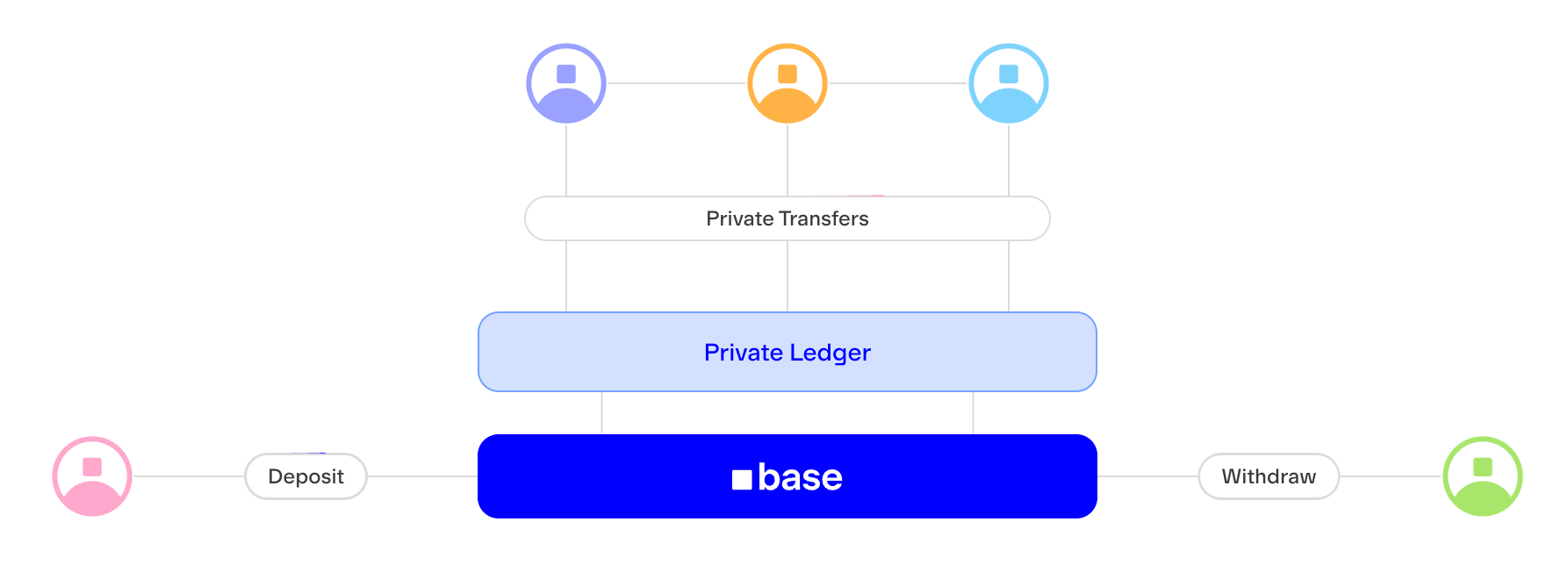 A payment moves through three stages:
1. **Deposit.** A user moves funds from Base into the ledger through the Portal contract. The recipient
remains encrypted, so deposits to one user remain unlinked. See [Deposit to the ledger](/build-on-base/ledgers-deposit-flow).
2. **Hold and transact in private.** Inside the ledger, users can transfer, swap, and earn yield while balances and activity remain private.
3. **Withdraw.** A user moves funds back to Base through the operator. Onchain, a withdrawal reveals
the asset and amount but not the account behind it, so deposits and withdrawals stay unlinkable.
See [Withdraw from the ledger](/build-on-base/ledgers-withdraw-flow).
## Who operates a ledger
An operator runs its own ledger and is responsible for its custody and compliance. Teams that
prefer not to operate one can use [Coinbase Managed](https://docs.cdp.coinbase.com/payments/overview), a managed service built on Base Ledgers.
## Request a demo
**Bring private payments to Base.**
Get started with the managed solution, or contact us about running your own ledger to [request access](https://www.coinbase.com/developer-platform/developer-interest).
A payment moves through three stages:
1. **Deposit.** A user moves funds from Base into the ledger through the Portal contract. The recipient
remains encrypted, so deposits to one user remain unlinked. See [Deposit to the ledger](/build-on-base/ledgers-deposit-flow).
2. **Hold and transact in private.** Inside the ledger, users can transfer, swap, and earn yield while balances and activity remain private.
3. **Withdraw.** A user moves funds back to Base through the operator. Onchain, a withdrawal reveals
the asset and amount but not the account behind it, so deposits and withdrawals stay unlinkable.
See [Withdraw from the ledger](/build-on-base/ledgers-withdraw-flow).
## Who operates a ledger
An operator runs its own ledger and is responsible for its custody and compliance. Teams that
prefer not to operate one can use [Coinbase Managed](https://docs.cdp.coinbase.com/payments/overview), a managed service built on Base Ledgers.
## Request a demo
**Bring private payments to Base.**
Get started with the managed solution, or contact us about running your own ledger to [request access](https://www.coinbase.com/developer-platform/developer-interest).